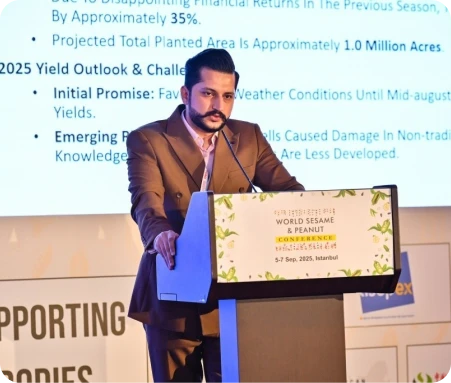
Pakistan’s sesame sector faced a challenging year in 2025, marked by weak prices, intense competition, and financial stress across the supply chain. Production in 2025 declined compared with 2024, following rapid acreage expansion and subsequent price correction. Looking ahead to 2026, production is expected to stabilise or marginally decline, rather than expand further.
The 2025 market remained bearish, largely due to China diversifying its sourcing toward other origins, which significantly pressured prices. Despite this, a positive structural shift emerged as new international markets, especially GCC countries and parts of Europe, increased purchases of Pakistani hulled sesame. These markets supported export continuity and helped improve Pakistan’s positioning beyond China.
Current price levels remain discouraging. Sesame is a rain-fed and high-risk crop, and many farmers who expanded acreage during the high-price phase have been demoralised by the sharp downturn. Given viable alternatives, farmers can quickly shift to other crops. During 2025, green mung beans attracted strong demand, especially from China, pushing local prices higher. As a result, farmers are increasingly considering green mung beans, canola, soybeans, and maize as substitutes.
In terms of production, harvested acreage fell from around 1.3 million acres in 2024 to about 1.0 million acres in 2025, translating into a crop size of approximately 300,000–320,000 MT. Exports up to December stood near 100,000 MT, alongside domestic consumption and border trade. Based on current offtake, carryover stocks of around 30–40% could move into 2026 if demand does not improve early in the year.
Buyer behaviour is expected to remain cautious. Major importers, particularly China, may delay purchases in 2026 if they anticipate adequate supply and further price softness in Pakistan. Competition from Brazil remains a key factor, as Brazilian harvest and seeding cycles overlap with Pakistan’s export window, giving buyers multiple sourcing options.
Quality trends improved in 2025. While rapid expansion in earlier years led to inconsistencies, exporters reported fewer issues related to FFA, moisture, and rejections during the latest season. Hybrid varieties now dominate cultivation in Sindh and Punjab, with average yields around 320 kg per acre. Further productivity gains are expected to be limited unless supported by better crop management and post-harvest handling, rather than genetics alone.
Price pressure intensified toward the end of the season, triggering distress sales by farmers and exporters, partly driven by the need to manage PKR–USD exposure. As a result, 2026 production is expected to be flat or lower, with no strong incentive for renewed expansion. A reduction of around 1020% in planted area is possible, primarily due to crop switching, though large investments in hulling and cleaning infrastructure and the sharp increase in exporter participation may limit the extent of contraction.
Despite the downturn, the cost of production in Pakistan remains relatively low compared with many origins. Even at current price levels, farmers are generally near break-even, though profitability has fallen sharply. Farm-gate prices declined from around PKR 22,000 per unit in 2024 to roughly PKR 10,000 in 2025, contributing to widespread demoralisation.
Pakistan’s export profile in 2025 showed stronger support from South Korea and GCC markets, while China remained a slower and more selective buyer due to ample inventories and Brazilian supply. Looking ahead, Pakistan retains a meaningful opportunity to strengthen its presence in Europe and the GCC, where buyers have expressed satisfaction with quality and compliance, particularly regarding pesticide standards.
Overall, 2026 represents a crossroads for Pakistan’s sesame sector. After rapid expansion and correction, the market is moving toward consolidation. Stability rather than growth is expected, with future gains dependent on consistent quality, disciplined supply, and diversified market access, rather than acreage expansion alone.
Global Sesame Markets in 2025 & Expectations For 2026